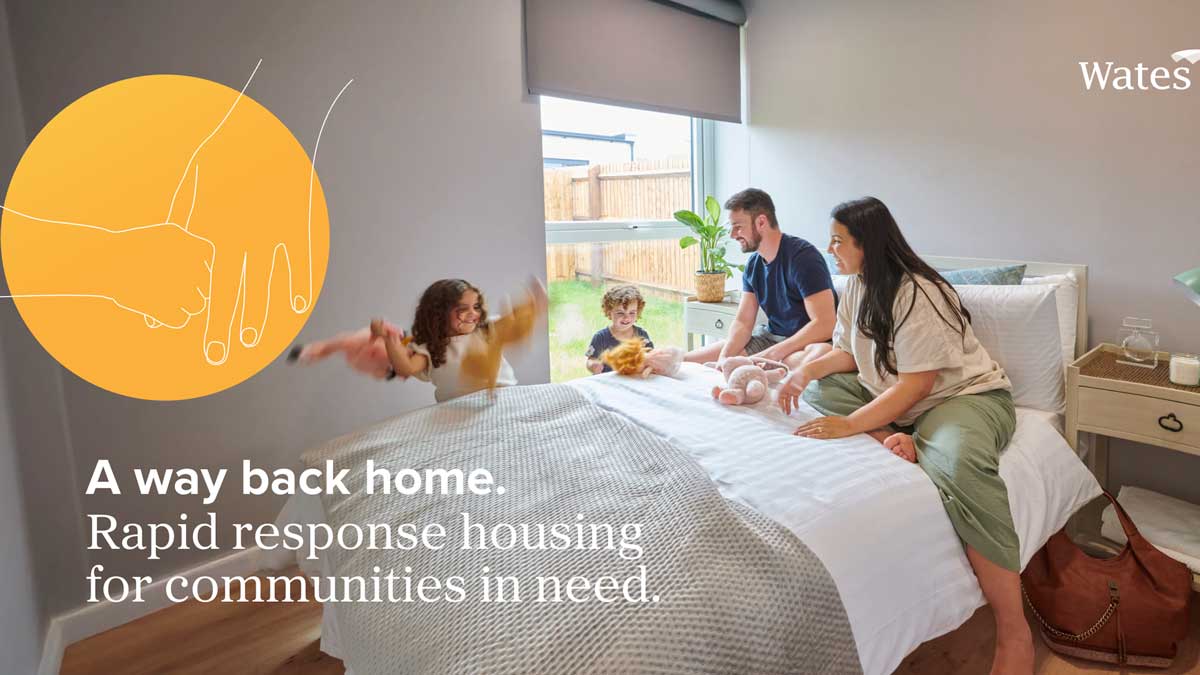
Image: Two-bedroom modular homes on Crofts Street in Cardiff
CASE STUDY
Modular solutions
How modular homes are providing sustainable solutions for families experiencing homelessness

INNOVATION & IMPROVEMENT

Issue 83 | April 2026
The following case study was developed through our work with the Temporary Accommodation Network (TAN). It highlights how Wates Residential, in partnership with local authorities, is using modular construction to deliver high-quality temporary and permanent homes for families experiencing homelessness. It demonstrates how modern methods of construction can provide faster, more flexible and cost-effective housing solutions while supporting sustainable outcomes.
Wates Residential is a leading family-owned residential developer-contractor, working in partnership with local authorities, housing associations and others to transform estates and shape places on brownfield sites across London, the south-east and Wales. In response to the temporary accommodation (TA) crisis, Wates has been exploring how modular homes could provide a more versatile and cost-effective solution, enabling the delivery of high-quality, safe and energy-efficient homes for homeless households who are waiting to move into a more permanent home.
Modern methods of construction
An example of this is Crofts Street, a disused site in Cardiff, where Wates partnered with the local council to deliver nine permanent two-bedroom homes. These were built offsite using modern methods of construction and lowered into position in just five weeks. They were designed to the same terraced style as local homes, with all the groundworks and landscaping completed in advance, minimising disruption to local neighbours.
The method of construction not only enabled the homes to be built and installed in record time but also used the latest technology and materials to create net-zero carbon buildings that meet Energy Performance Certificate A and are 90% more energy efficient than standard homes built to current regulations. The homes are well insulated, and so residents see huge savings on their bills.
A modular housing unit is craned into place
“The method of construction not only enabled the homes to be built and installed in record time but also used the latest technology and materials to create net-zero carbon buildings that meet Energy Performance Certificate A and are 90% more energy efficient than standard homes built to current regulations.”
Flexible homes
Wates has also delivered 155 relocatable modular homes for Cardiff City Council. Gasworks transformed a former industrial site in Cardiff into a vibrant community of modular homes. This project began as an urgent response to the city’s housing crisis and is now a benchmark for speed, quality and sustainability.
Modular housing can be placed on almost any site, but they are particularly suitable for ‘meanwhile’ use on brownfield or large phased-development sites with good access to infrastructure and amenities, especially those already allocated within local plans.
The product can be relocated for use on other sites as needed and is best delivered through a lease/leaseback model via the local authority to provide greater certainty.
Building on this successful scheme in Cardiff, Wates is currently working to roll out a similar scheme in Romford, principal town of the London Borough of Havering. Here, a planning application was recently submitted as part of a 12-year joint venture with the local council to regenerate estates and build new homes.
A planning application has been submitted to build modular homes in Romford
Wates' Crofts Street modular homes are 90% more energy efficient than standard homes built to current regulations
Number of relocatable modular homes Wates has delivered for Cardiff City Council
annual saving of providing modular housing per adult compared to private rented accommodation (rising to £63,500 for those in hotels or B&Bs)
Benefits and savings
The potential benefits of modular solutions are huge, especially compared to hotels and hostels. Wates estimate that providing such housing generates an annual saving of £44,000 per adult compared to private rented accommodation (rising to £63,500 for those in hotel or B&Bs). Modular solutions also add social and community value by offering local solutions, which enable people to remain in their communities.
Modular could have an even greater potential impact if supported by planning reforms to create a new use class for modular housing and more access to grant funding through programmes, including underused funds and flexibility to follow the site.
Wates recently developed a Modular Playbook, offering a detailed insight into how modular housing can be effectively implemented to address housing challenges. The playbook explores key benefits, design principles, and case studies showcasing the impact of modular solutions.