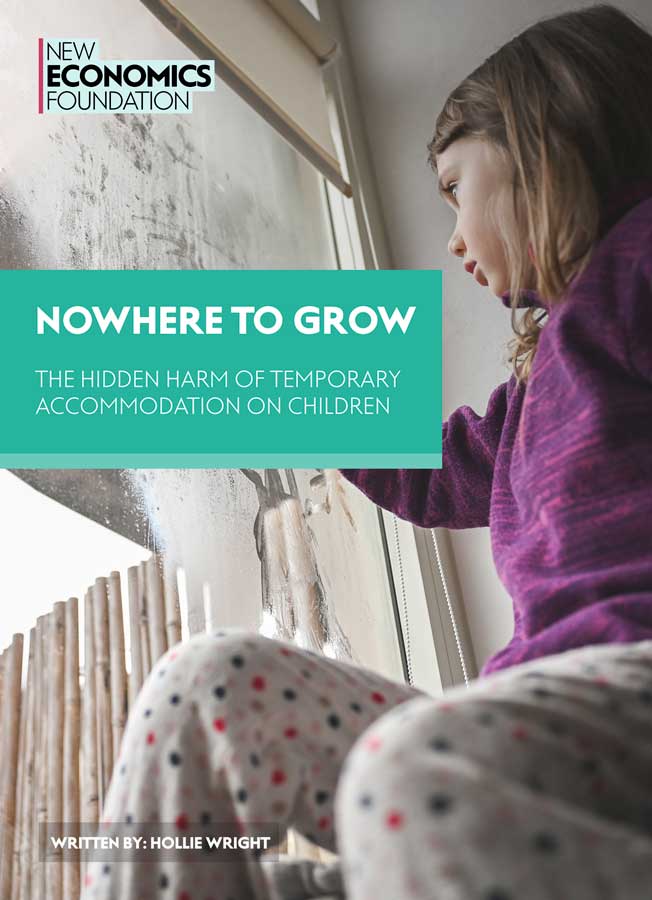
Image: Istock
Nowhere to grow
The psychological impact of temporary accommodation on families and children

HEALTH, CARE & SUPPORT

Hollie Wright
Assistant Researcher, New Economics Foundation
Hollie Wright
Assistant Researcher New Economics Foundation
Issue 83 | April 2026
More than 170,000 children in England are living in temporary accommodation (TA). More than two-thirds have been there for more than a year, rising to over four-fifths in London. Temporary accommodation is meant to be an emergency measure, but now an increasing number of children are growing up in an unsuitable, unstable tenure that is harming their health and development.
Our New Economics Foundation report, Nowhere to Grow, published in August, investigated the harm done to children by protracted stays in TA, interviewing affected families, frontline professionals, and key stakeholders.
We found out that 30% of families in temporary accommodation have lived in three or more placements, sometimes moved on with as little as 48 hours’ notice. School runs are impossible, childhood friendships are broken, and stabilising routines collapse.
of families in temporary accommodation have lived in three or more placements, sometimes moved on with as little as 48 hours’ notice
Impacting mental health and education
Inevitably, children’s mental health and development take a hit. Homeless children are estimated to be three to four times more likely to experience mental health problems than other children. The uncertainty of where you will stay next month, the tension absorbed from a parent who is constantly firefighting, and the erosion of privacy when a whole family is forced into one room all make it challenging for a child to emotionally regulate.
Poor physical environments worsen psychological harm:
- 75% of families in temporary accommodation reported poor conditions
- 68% lacked adequate access to basic facilities such as cooking or laundry
- 35% said their children did not have their own bed
Damp, mould, cold, and vermin are endemic, and serve to disrupt sleep, worsen respiratory conditions, and spread disease. According to the National Child Mortality Database, 80 children have died in temporary accommodation in the past year.
For families with neurodivergent children or additional needs, the situation is even harder. We heard of siblings whose needs competed in a single room: one child required darkness and quiet to stay regulated, while another self-soothed through movement and repetitive noise. There is no “good” compromise in that set-up. A paediatric academic interviewed for the report noted that many children living in temporary accommodation develop anxiety and depression despite previous good health.
School is often the one stable institution left, yet life in TA makes it much harder to attend. Almost half of children living in temporary accommodation have had to move schools at least once, and more than a third of those missed over a month. Teachers describe children arriving tired, hungry, and unable to concentrate, and some children exit education entirely.
“A paediatric academic interviewed for the report noted that many children living in temporary accommodation develop anxiety and depression despite previous good health.”
“A paediatric academic interviewed for the report noted that many children living in temporary accommodation develop anxiety and depression despite previous good health.”
“A paediatric academic interviewed for the report noted that many children living in temporary accommodation develop anxiety and depression despite previous good health.”
number of children in England currently living in temporary accommodation
homeless children are estimated to be three to four times more likely to experience mental health problems than other children
children have died in temporary accommodation in the past year
The need for a collaborative approach
For families already under pressure, it is harder to push for the adjustments their child needs, and weak communication between services means they get bounced between services with no one taking responsibility. Council housing departments focus on securing a placement, schools on attendance, GPs on symptoms, and little is shared between. Families are left carrying their story from office to office, often afraid to disclose too much because of stigma and the power imbalance with authorities.
The recommendations we developed through our co-production roundtables tackle these realities. For example, a local authority TA support coordinator would give families a consistent point of contact and make sure each service knows who else is involved. A local duty to communicate across housing, health, education, and social care would make joint planning routine when a child enters temporary accommodation.
There is some good news – in December, ministers announced a new legal duty for councils to notify schools and health services when a child is placed in temporary accommodation, so support can start earlier. But if the government is serious about ending the epidemic of children in TA, we must build and secure enough genuinely affordable homes for families.
Hollie is an assistant researcher at the New Economics Foundation focusing on housing, wealth, and social security. Prior to joining NEF, she worked as a policy adviser at HM Treasury, specialising in universal credit and welfare spending.
“For families already under pressure, it is harder to push for the adjustments their child needs, and weak communication between services means they get bounced between services with no one taking responsibility.”