Image: Istock
Meeting the standards
What Ireland's Approved Housing Bodies need to demonstrate
REGULATION

Fergal O'Leary
Chief Executive Officer, Approved Housing Bodies Regulatory Authority (AHBRA)
Fergal O'Leary
Chief Executive Officer, Approved Housing Bodies Regulatory Authority (AHBRA)
Issue 85 | September 2026
Approved Housing Bodies (AHBs) now provide almost 77,000 homes across Ireland and play an increasingly important role in delivering social and affordable housing. As the sector has grown in scale, complexity and significance, maintaining public confidence through strong governance, financial resilience and positive outcomes for tenants has become more important than ever.
The Approved Housing Bodies Regulatory Authority (AHBRA) was established in 2021 to provide independent statutory oversight of the sector. In the first years of operation, AHBRA’s focus was on establishing the regulatory framework, including the Register of Approved Housing Bodies, the Standards for Approved Housing Bodies and a range of regulatory processes that support proportionate oversight.
With the framework fully operational and having gathered five years of regulatory information on the sector, attention is increasingly turning to what good regulation looks like in practice. What do AHBs need to demonstrate to provide confidence to tenants, funders and the wider public.
number of homes across Ireland that are provided by Approved Housing Bodies
Setting the Standards
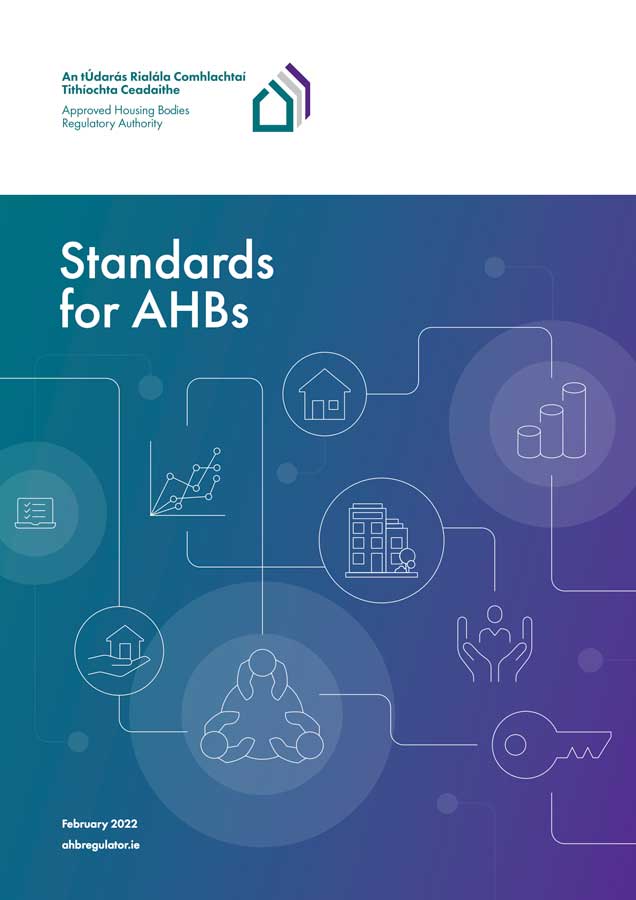
At the heart of the framework are the Standards for Approved Housing Bodies. They set out the outcomes every AHB is expected to demonstrate across governance, financial management, property and asset management and tenancy management. The Standards are intentionally outcomes-focused rather than prescriptive, recognising the diversity of the sector while providing a consistent benchmark against which organisations can be assessed.
Good governance remains the foundation of effective regulation. AHBRA’s experience has found that organisations with strong governance arrangements are generally better equipped to manage financial pressures, operational challenges and organisational change while continuing to deliver high-quality services to tenants.
This is not simply a function of size. Smaller AHBs with effective governance can be just as well placed as larger organisations to identify, manage and respond to the challenges they face.
For Boards, this means seeking assurance rather than simply receiving reports. Effective governance requires constructive challenge, oversight of key risks and confidence that appropriate controls are operating across the organisation.
AHBRA’s regulatory approach is proportionate and risk based. Applying the same level of oversight to every organisation would neither be effective nor in the interests of tenants or the sector.
Instead, regulatory activity is informed by a range of information, including annual monitoring returns, assessments, Notifiable Events, concerns raised with AHBRA and engagement with AHBs and other stakeholders. Bringing these sources together allows regulatory decisions to be evidence-based and proportionate to the circumstances of each organisation.
“Effective governance requires constructive challenge, oversight of key risks and confidence that appropriate controls are operating across the organisation.”
Notifiable Events
An important element of this approach is the Notifiable Events framework. Timely notification enables AHBRA to understand emerging issues, assess potential risks and determine whether any regulatory response is required. Importantly, making a notification does not, in itself, indicate non-compliance.
Rather, it demonstrates openness and supports early engagement where issues arise. Effective regulation depends on organisations engaging openly with their regulator and providing timely information when material issues occur.
Alongside formal regulatory activity, constructive engagement with the sector is an essential part of AHBRA's approach. Guidance, dialogue and ongoing communication help build a shared understanding of regulatory expectations while recognising the different size, complexity and operating models of individual AHBs.
This engagement also strengthens regulation by providing valuable insight into emerging risks, operational challenges and areas where additional clarity or guidance may be beneficial.
Meeting Ireland’s housing needs
Effective regulation promotes good governance, safeguards tenants, protects public investment and builds confidence in a sector that plays a vital role in meeting Ireland's housing needs. It encourages AHBs to build strong governance and assurance arrangements that enable them to manage risk effectively, respond to change and continue delivering high-quality homes and services.
As both the sector and the regulatory framework continue to mature, expectations will continue to evolve. By maintaining a proportionate, evidence-based approach and fostering constructive engagement, AHBRA aims to support a resilient sector that is well governed, financially sustainable and focused on delivering positive outcomes for tenants. That is the foundation on which lasting public confidence in the Approved Housing Body sector will continue to be built.
Further information on AHBRA’s regulatory framework, the Standards for Approved Housing Bodies and regulatory guidance is available here.