Image: Istock
CASE STUDY
Fix the Five Basics
How a campaign launched by the Better TA alliance is improving living conditions in temporary accommodation across London

INNOVATION & IMPROVEMENT

Issue 77 | April 2025
The following case study was collected through our work so far on the Temporary Accommodation Network (TAN). It showcases how Trust for London is working with local authorities in the capital to influence the quality of temporary accommodation (TA) being provided, with a particular focus on how the quality of accommodation and support services can make a real impact on the lives of families facing homelessness.
From campaign to implementation
The Fix the Five Basics campaign, launched in July 2025 by the Better TA alliance, sets out a clear and practical framework for improving conditions in temporary accommodation (TA). It identifies five indispensable amenities – kitchens, laundry facilities, Wi-Fi, storage and good quality information – which are often missing. Without these basics, families cannot function day to day, let alone recover and move on.
There is significant variation between London local authorities in provision of the basics. Families face a postcode lottery – not only in access to facilities like kitchens or washing machines, but also in the level of financial support offered when placements in hotels or bed and breakfasts cannot be avoided.
The campaign was developed in response to this gap. Convened and funded by Trust for London, the Better TA alliance brings together 20 London-based organisations working with people in TA across frontline delivery, legal advice, research, policy and advocacy. It works with local authorities to support practical implementation of the Five Basics.
“Families face a postcode lottery – not only in access to facilities like kitchens or washing machines, but also in the level of financial support offered.”
Campaign asks
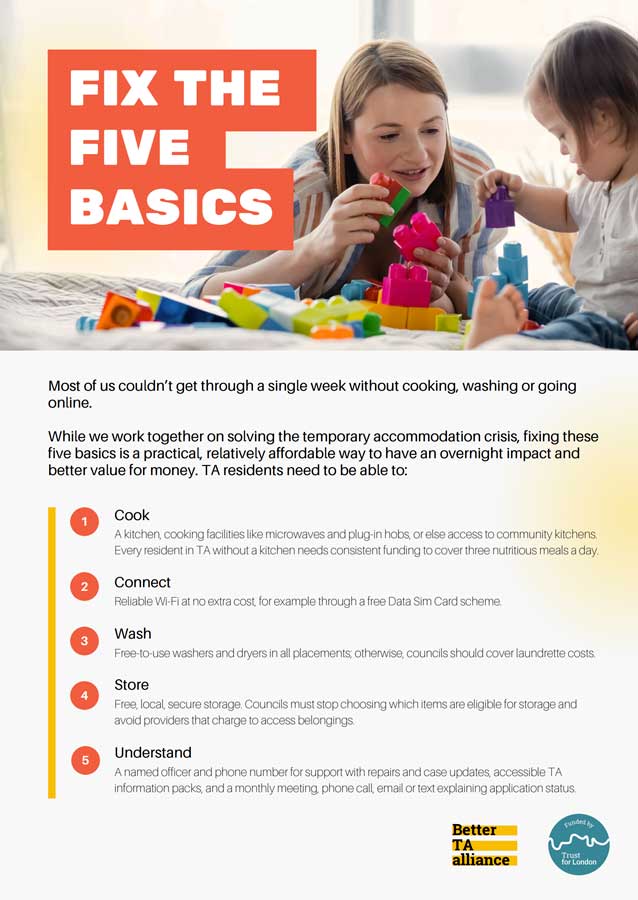
The campaign calls for every resident in temporary accommodation to be able to:
- Cook: A kitchen, cooking facilities, like microwaves and plug-in hobs, or else access to community kitchens. Every resident in temporary accommodation without a kitchen needs consistent funding to cover three nutritious meals a day.
- Wash: Free-to-use washers and dryers in all placements; otherwise, councils should cover laundrette costs.
- Connect: Reliable Wi-Fi at no extra cost, for example through a free Data Sim Card scheme.
- Store: Free, local, secure storage. Councils must stop choosing which items are eligible for storage and avoid providers that charge to access belongings.
- Understand: A named officer and phone number for support with repairs and case updates, accessible temporary accommodation information packs, and a monthly meeting, phone call, email or text explaining application status.
Good practice
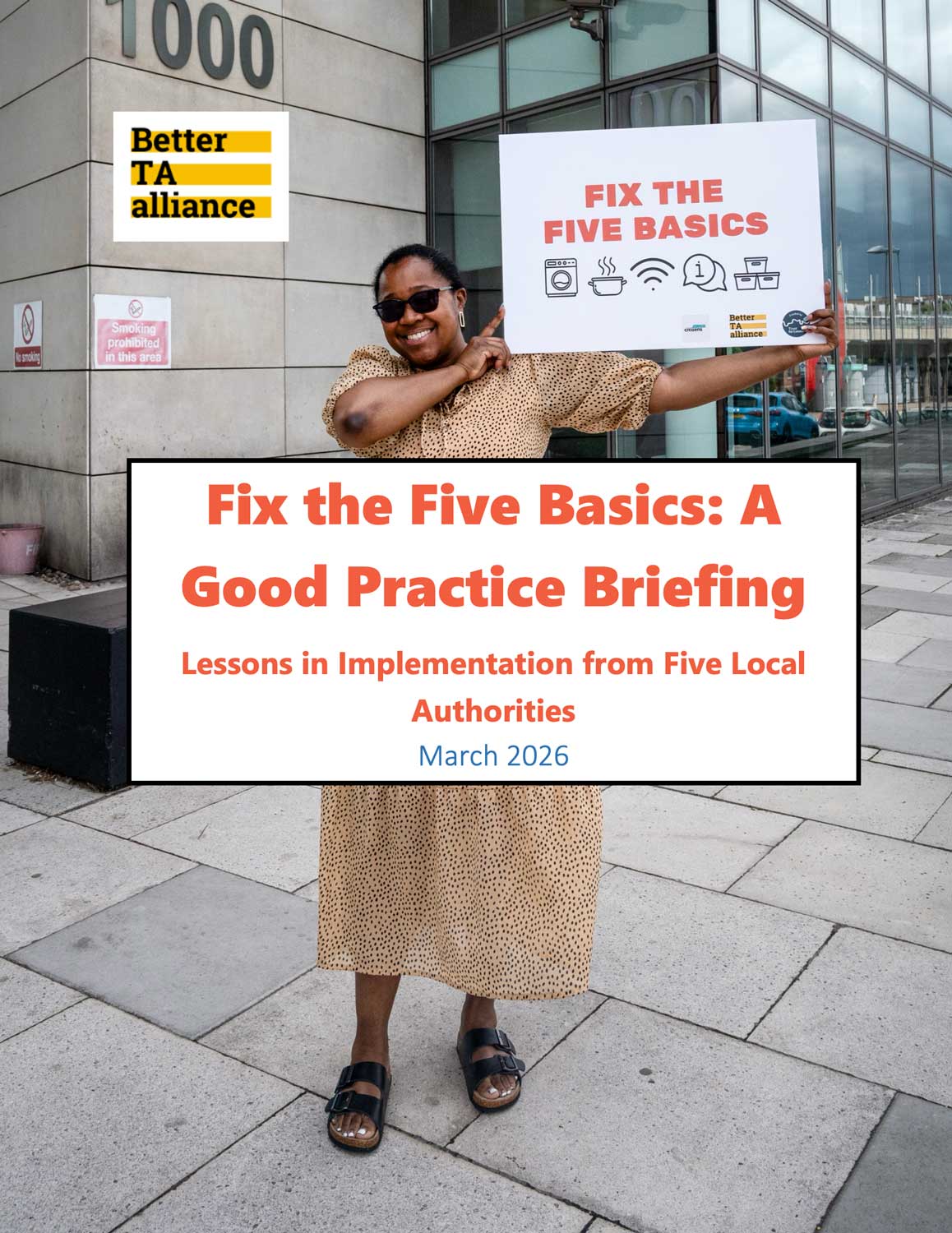
For senior officers, the challenge is not whether the Five Basics matter, but how to deliver them within existing financial and operational constraints. A new Good Practice Briefing (March 2026) responds directly to this challenge, drawing on examples from five London boroughs to highlight what is already being implemented, how it is being funded, and what lessons can be applied elsewhere.
Across the case studies, one of the most consistent findings is that delivering the Five Basics is primarily a systems and coordination issue, rather than a purely financial one. Many interventions are low-cost or one-off investments, particularly when compared to the rising cost of TA itself, which has increased significantly in recent years.
A number of boroughs have focused on embedding the Five Basics upstream in procurement and commissioning processes. For example, Wandsworth has incorporated requirements for kitchens, laundry facilities, and Wi-Fi into new TA contracts. This approach reduces the need for reactive mitigation by ensuring that provision is built into placements from the outset.
Other authorities are testing targeted, short-term interventions. Southwark’s use of vouchers to cover laundry costs in a leased hostel demonstrates a ‘test and learn’ approach, using time-limited funding to assess impact before committing to longer-term provision. This kind of evaluation is critical in building the internal business case for scaling interventions.
Partnership working also plays an important role in delivery. In Greenwich, a prepaid SIM card scheme delivered with Good Things Foundation has provided low-cost digital access to residents, while also linking them into local services. Similarly, engagement with social tariff providers has enabled some boroughs to explore affordable Wi-Fi solutions in hostels and other TA settings without requiring significant capital investment.
Storage provision highlights how local flexibility can be applied. Richmond, for instance, offers free storage to residents in receipt of benefits, while other boroughs are reviewing contracts or exploring the use of council-owned assets, such as garages, to reduce costs and improve access.
A further practical step identified in the briefing is the importance of mapping current provision. Several authorities reported that understanding which households lack access to the basics allowed them to better target resources and revealed that the scale of need was often more manageable than initially assumed.
“One of the most consistent findings is that delivering the Five Basics is primarily a systems and coordination issue, rather than a purely financial one.”
Policy alignment
The briefing also reflects a wider policy context. Recent government funding, including the Supporting Children Experiencing Homelessness allocation, explicitly identifies access to facilities such as laundry, Wi-Fi and food as appropriate uses of funding. This creates an opportunity for housing teams to align delivery of the Five Basics with existing funding streams, including the Homelessness Prevention Grant and Household Support Fund.
Overall, the Good Practice Briefing is intended as a practical tool for housing officers. It sets out realistic approaches to delivery, highlights where costs can be contained or shared, and reinforces that incremental changes — particularly when tested and evaluated — can improve outcomes for households in TA.
Fix the Five Basics: Sharing Good Practice Across London
Monday 15 June 2pm | London Councils
Senior officers and interested practitioners are invited to attend the Fix the Five Basics: Sharing Good Practice Across London event, which will bring together boroughs and third sector partners to discuss implementation in more detail, share learning, and explore practical next steps.
Register here.