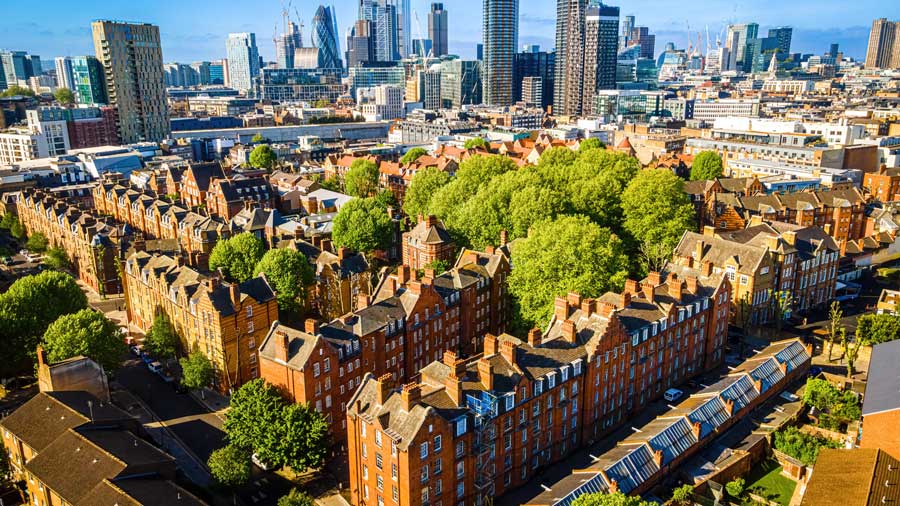
The finished exterior of Zodiac House (image: Agnese Sanvito)
CASE STUDY
Zodiac House
How a disused commercial building was converted into high-quality emergency accommodation for families facing homelessness in Croydon

INNOVATION & IMPROVEMENT
The finished exterior of Zodiac House (image: Agnese Sanvito)
Issue 83 | April 2026
The following case study was developed through our work with the Temporary Accommodation Network (TAN). It highlights how Common Projects is transforming disused commercial space into high-quality temporary accommodation (TA) for families facing homelessness. It demonstrates how, with local authority support, repurposing buildings can improve the quality of homes available and reduce reliance on costly private sector provision.
Zodiac House, a 1960s office block in West Croydon, has been transformed into 73 high-quality homes now owned by the London Borough of Croydon (LBC) to house local residents facing homelessness. Empty for more than 30 years, the building was repurposed instead of being demolished and illustrates how conversion of redundant commercial space can play a significant role in addressing the TA crisis, as well as easing funding issues for local authorities, which spend £2.84 billion every year providing mostly private-sector TA.
Zodiac house before its transformation from a commercial building into 73 emergency accommodation apartments (image: Havelock Photography)
Sustainable retrofit
Development finance from Homes England and the retrofit expertise of architects Shedkm and engineers Whitby Wood saw the delivery of a full internal retrofit, converting office floors into self-contained, spacious one, two and three-bedroom apartments, designed to maximise light, privacy and comfort.
A formerly neglected undercroft has been reimagined as a residents’ lounge, while the external forecourt now hosts a multifunctional green space, landscaped garden and timber community pavilion. Residents are benefiting from modern apartments and shared spaces fostering a sense of community, in a well-connected location. Crucially, the use of permitted development rights (PDR) allowed the homes to be delivered without lengthy planning delays.
The homes were purchased by LBC as a long-term asset, allowing the council to offer a better standard of TA , while reducing its dependence on expensive private sector lets.
Zodiac House is a clear example of how re-using vacant office buildings can offer a faster, greener and more dignified response to temporary housing need. It shows how by using PDR for good, working with committed local authorities, and applying design-led thinking, disused commercial buildings can become a model for tackling homelessness across the UK.
The finished interior of Zodiac House is bright, comfortable and modern (images: Agnese Sanvito)
“This will improve the council’s supply of accommodation and reduce spending on other expensive temporary arrangements, as well as providing safe and secure homes for our residents.”
Doing things differently
Jason Perry, Executive Mayor of Croydon, said: “This is another step in addressing the significant homelessness challenges we face. The increased demand for services and shortage of accommodation means we have to look at doing things differently, and the purchase of Zodiac House is a good example of this. The scheme will give us 73 residential units to support residents facing homelessness. This will improve the council’s supply of accommodation and reduce spending on other expensive temporary arrangements, as well as providing safe and secure homes for our residents.
Nigel Barclay, Loans Director at Homes England, said: “This latest milestone for Zodiac will enable Common Projects and Croydon Council to transform a derelict site into family emergency housing, whilst minimising carbon emissions during the construction process. This is a significant moment for the project and an excellent example of how we are supporting SMEs that are crucial to building a diverse and resilient housing sector.”